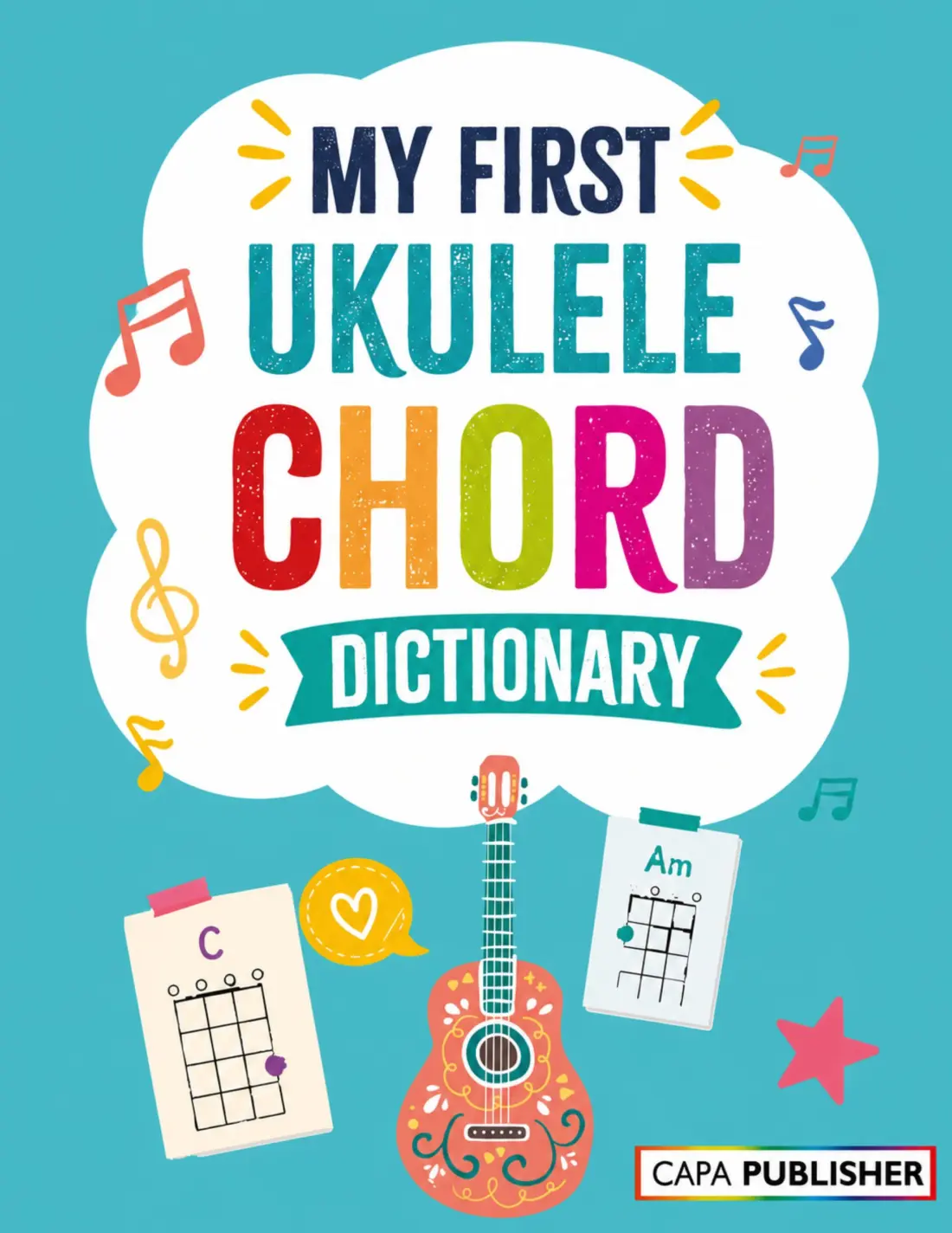
My first ukulele chords dictionary
By Joan Capafons
€14.72incl. VAT
ISBN 9781291642292 · Ref. CAPAPUB-86311
About the book
This book is a complete music teaching resource for getting started on the ukulele, designed especially for children, teachers and schools in Catalonia who want to work on music in a practical, motivating and cross-curricular way, while also bringing English learning into the classroom.
The material helps children discover and practise the most basic chords on the soprano ukulele, presented in a clear, visual and progressive way. The book introduces nine essential chord types: major, minor, diminished, sus4, augmented, major sixth, seventh, major seventh and add9, so pupils can start accompanying songs from the very first lessons.
It isn’t just a chord dictionary. The book provides a solid foundation for understanding the instrument and playing it independently, including:
-
the different types of ukulele
-
the parts of the instrument
-
how to tune the ukulele correctly
-
what the right hand and left hand do
-
how to read chord diagrams
-
the equivalence between Latin and English note names (Do = C, Re = D…), a key element for connecting music education with learning English
The book also includes a songbook of traditional English songs, all with very simple chords, ideal for working on music, English, pronunciation and vocabulary together in a natural, meaningful way. The repertoire includes well-known songs such as Old MacDonald, Twinkle, Twinkle, Mary Had a Little Lamb, London Bridge, The Wheels on the Bus, Alphabet Song, Happy Birthday and Row, Row, Row Your Boat, among others.
Finally, the book includes two examples of the blues structure in the keys of A and C, as a first approach to basic musical forms and improvisation, adapted to beginner level.
Material especially suitable for primary education, music schools and CLIL projects, enabling children to learn music and English together and encouraging teamwork, independence and the joy of making music from the very first moment.